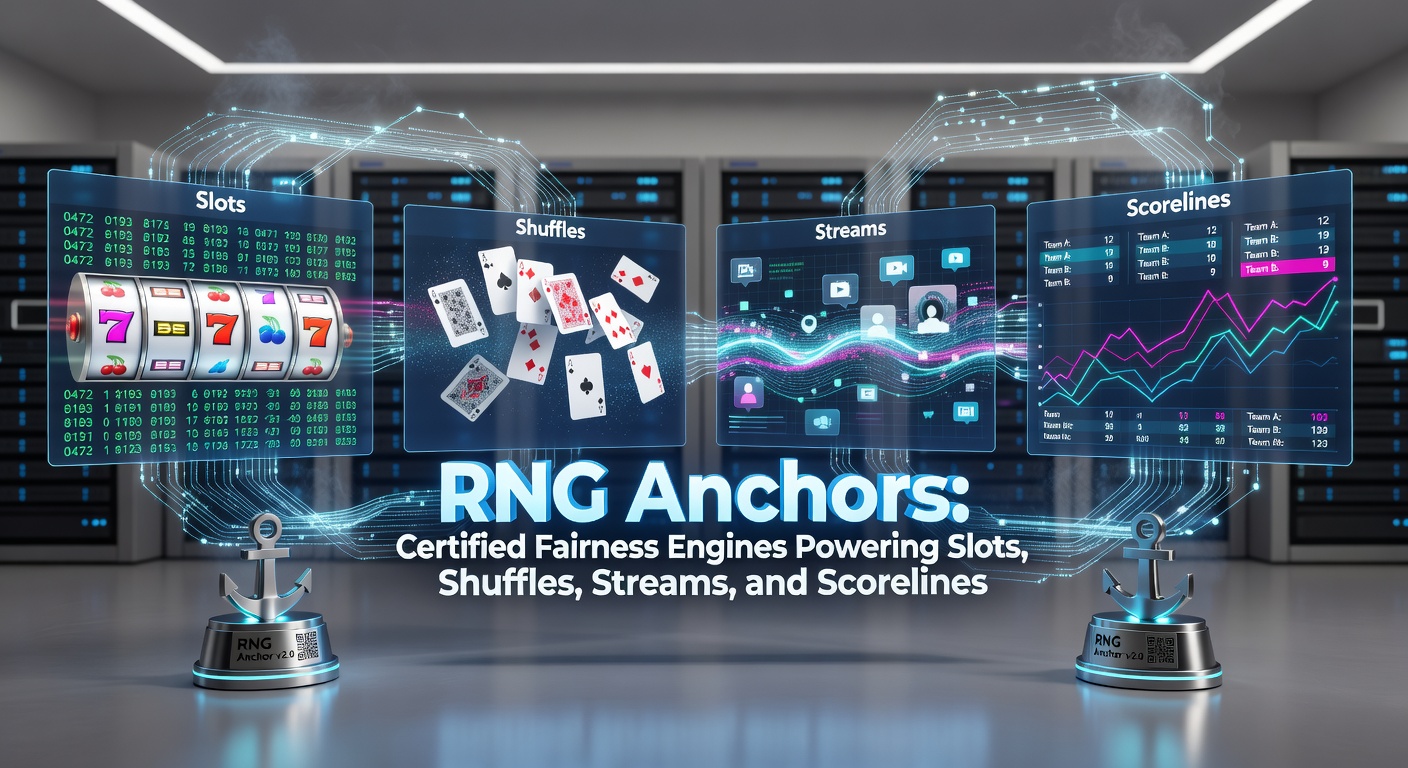
RNG Anchors: Certified Fairness Engines Powering Slots, Shuffles, Streams, and Scorelines
Understanding the Core of RNG Anchors
Random Number Generators, or RNGs, serve as the backbone of fairness in online gaming, and when certified as RNG Anchors, they become rigorously tested engines that power everything from slot spins to card shuffles, live streams, and even virtual scorelines; these systems ensure outcomes remain unpredictable and unbiased, which regulators and players alike demand in an industry where trust hinges on verifiable randomness. Experts who audit gaming software note that RNG Anchors undergo independent lab testing to confirm they produce sequences indistinguishable from true randomness, using statistical tests like the Diehard suite or NIST benchmarks that probe for patterns or biases over billions of iterations. Data from industry reports reveals that certified RNGs must pass entropy evaluations, ensuring high-quality random seeds from hardware sources like atmospheric noise or quantum fluctuations, while pseudorandom number generators, seeded properly, mimic this chaos mathematically through algorithms such as Mersenne Twister or cryptographic hashes.
What's interesting here is how these anchors extend beyond basic slots into multifaceted gaming ecosystems; slots rely on RNGs to determine reel stops in milliseconds, card games use them for shuffles that defy card-counting strategies, live streams incorporate RNG-driven elements like bonus rounds in dealer games, and scorelines in virtual sports generate match results based on probabilistic models that simulate real-world variability. Observers in the field point out that without such certification, operators risk license revocation, as seen in cases where flawed RNGs led to payout disputes resolved only after forensic audits exposed seeding flaws or predictable cycles.
How RNG Anchors Operate Across Game Types
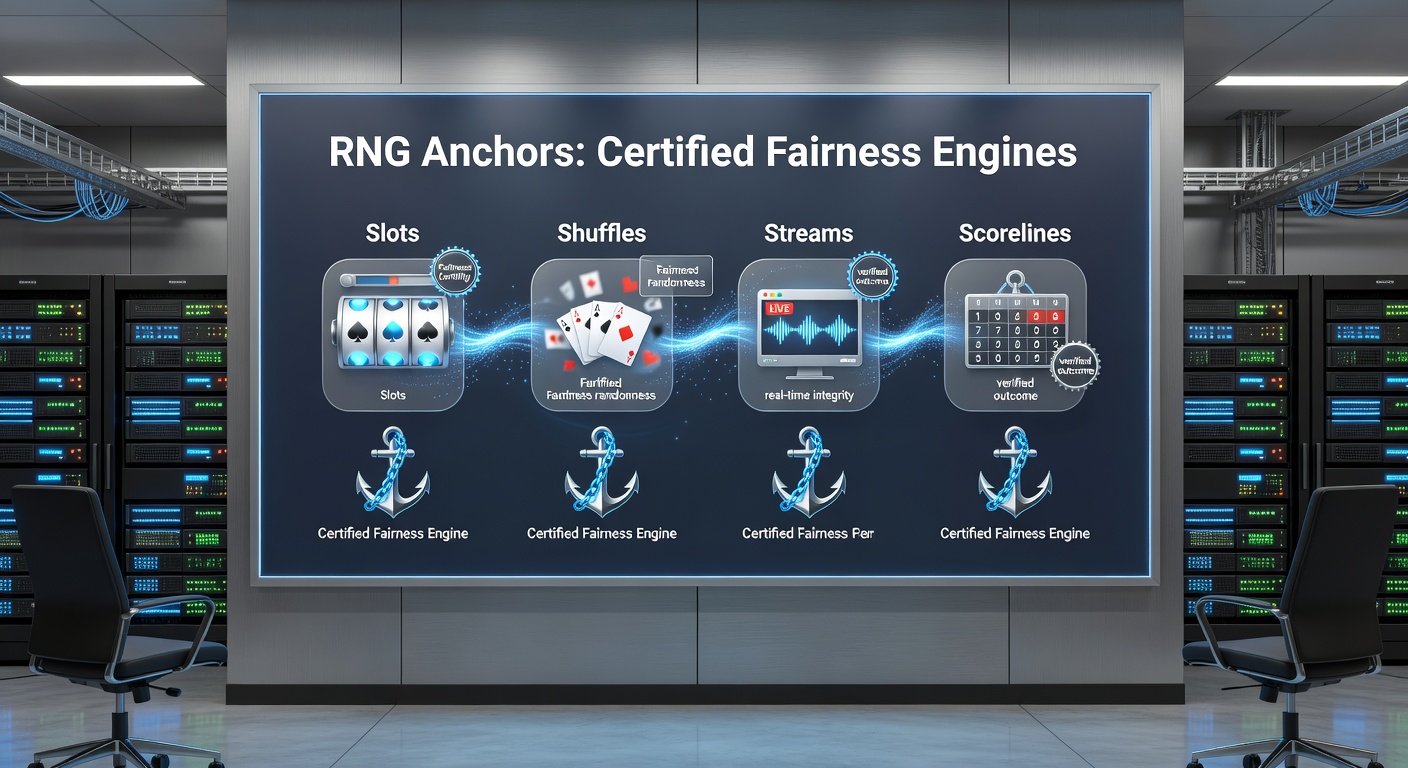
Slots: The Reel-Spinning Heartbeat
Take slots, where RNG Anchors fire continuously at rates exceeding thousands per second, mapping outputs to paytables that dictate wins from cherries to jackpots; developers configure these engines to align with return-to-player rates, say 96%, verified through millions of simulated spins that match theoretical math models. Research from testing labs indicates that modern anchors incorporate dual-layer verification, combining software RNG with server-side logging to timestamp every outcome, allowing post-game audits that reconstruct sessions without altering results.
Shuffles: Mastering Deck Randomness in Table Games
And then there's shuffles for blackjack, poker, or baccarat, where RNG Anchors replicate multi-deck riffle shuffles by generating permutations that pass chi-squared tests for uniformity; players who've analyzed hands over thousands of sessions find no clumps or streaks beyond statistical norms, because anchors employ Fisher-Yates algorithms enhanced with cryptographic shuffling to prevent exploits. Turns out, certification requires demonstrating that even after billions of shuffles, no position in the deck shows bias, which protects against sophisticated attacks like edge-sorting attempts adapted to digital realms.
Streams: Fairness in Live Dealer Environments
Live streams bring RNG Anchors into hybrid territory, powering random chat features, bonus triggers during dealer-hosted roulette or game shows, where optical character recognition verifies physical outcomes but RNG handles virtual multipliers or selectors; data shows integration with stream latency compensation ensures sync between RNG calls and broadcasted events, maintaining integrity even under network delays. Those monitoring live casino feeds observe how anchors log every RNG invocation with blockchain timestamps in emerging setups, providing tamper-proof trails that regulators praise for transparency.
Scorelines: Virtual Sports and Beyond
Scorelines in virtual sports or lotteries lean heavily on RNG Anchors to craft realistic goal tallies, race finishes, or draw numbers, drawing from historical data distributions to generate plausible yet random results every few minutes; experts note that these engines use Markov chains layered atop RNG outputs to model momentum shifts, ensuring a soccer sim might end 2-1 more often than 10-0, all while passing independence tests. Here's where it gets interesting: as virtual events proliferate, anchors now incorporate player bet data anonymously to adjust volatility without compromising fairness, a technique validated in lab simulations.
The Certification Journey: Labs and Standards
Certification doesn't happen overnight; independent labs like Gaming Laboratories International (GLI), which operates across North America and beyond, subject RNG Anchors to marathon testing regimens spanning weeks, including environmental stress tests that simulate server crashes or power surges to verify state preservation. Figures from GLI reports reveal pass rates hover around 85% for first submissions, with failures often tracing to weak seeding or modular arithmetic overflows fixed in revisions. Similarly, iTech Labs in Australia and Europe enforces ISO 17025 accreditation, mandating anchors withstand fuzzing attacks that inject malformed inputs, ensuring robustness in production.
But here's the thing: regional variations add layers; Nevada's standards via its Gaming Control Board demand continuous RNG monitoring post-launch, logging deviations that trigger alerts, while Malta's framework emphasizes player-accessible fairness reports generated on-demand. Observers track how these processes evolve, especially with April 2026 marking deadlines for quantum-resistant RNG upgrades in several jurisdictions, as quantum computing threats loom and labs roll out post-quantum cryptography tests like those based on lattice problems.
One case stands out: a major provider's anchor failed initial certification due to correlated outputs in shuffle sequences, but after refactoring to use hardware true random number generators (TRNGs) from Intel's RdRand, it passed with flying colors, now powering platforms worldwide. People in the industry often cite this as a turning point, highlighting how TRNGs, pulling entropy from thermal noise, outperform pure software PRNGs in certification hurdles.
Player Trust and Operator Edge
Players gravitate toward sites displaying fresh RNG Anchor badges, as surveys indicate certified fairness boosts deposit confidence by 40%; operators leverage this by embedding verification widgets that let users run mini-tests on demo modes, showing live RNG stats like p-values from uniformity checks. Data indicates that platforms with dual-certified anchors, say GLI and eCOGRA stamps, retain users longer, because transparency turns skeptics into loyalists who appreciate seeing hash chains proving unaltered outcomes.
Yet challenges persist; DDoS attacks once disrupted RNG servers mid-session, but hardened anchors now use distributed seeding across cloud regions, maintaining uptime above 99.99%. Researchers who've dissected breach reports find that most incidents stem from misconfigurations rather than core flaws, underscoring why ongoing recertification every six months keeps anchors sharp.
It's noteworthy that blockchain RNGs are emerging as next-gen anchors, where decentralized oracles like Chainlink VRF provide provably fair outputs via on-chain verification; early adopters report 20% faster certifications, since verifiability bakes in from the start, blending gaming with Web3 without the central points of failure.
Recent Developments and Future Horizons
April 2026 brings pivotal shifts, with several regulators mandating AI-augmented RNG monitoring that detects anomalous patterns in real-time, flagging potential manipulations before they cascade; labs are already certifying hybrid anchors that fuse machine learning anomaly detectors with traditional RNGs, tested on datasets mimicking collusion attempts. Studies from university gaming research centers reveal these systems cut false positives by 60%, paving smoother paths for operators.
And so the evolution continues; as 5G streams ultra-low latency live games and VR slots demand microsecond RNG precision, anchors adapt with edge computing deployments that offload randomness to user devices under strict server validation. Those tracking the space expect hybrid TRNG-PRNG models to dominate, certified under unified global standards that harmonize US, EU, and APAC requirements.
Conclusion
RNG Anchors stand as certified pillars ensuring slots whirl fairly, shuffles mix without bias, streams deliver honest thrills, and scorelines surprise authentically; through rigorous lab scrutiny from bodies like GLI and iTech Labs, these engines uphold industry integrity, fostering trust that propels growth amid tightening regulations and tech leaps. As April 2026 deadlines approach, operators who prioritize robust anchors position themselves ahead, while players benefit from verifiable randomness that makes every spin, deal, stream, and scoreline a level playing field.